
Most sports bettors judge themselves by one thing!
Did the bet win?
Professional bettors ask a completely different question:
Did I beat the closing line?
That single shift in mindset separates recreational gamblers from long term winning bettors.
If you’ve watched our video on Closing Line Value (CLV), this article expands on the concepts and explains why CLV is one of the most important metrics in sports betting.
What is Closing Line Value?
Closing Line Value (CLV) is simply the difference between:
- The odds you took when placing your bet.
- The odds available just before the event starts (the closing line).
For example:
- You back Hradec Kralove at 3.80
- By kick-off they’re 3.25
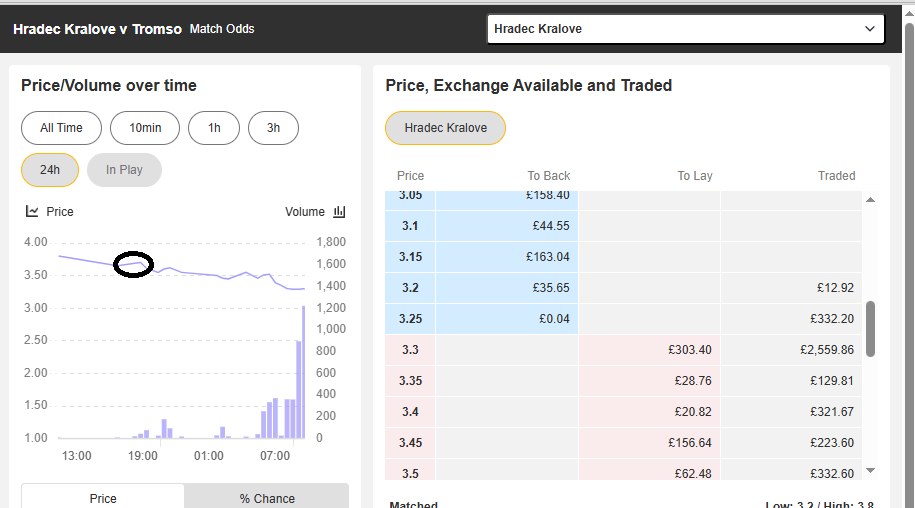
You have achieved positive Closing Line Value.
If instead you backed them at 3.25 and they closed at 3.80, you’ve taken negative CLV.
The closing line represents the market’s final consensus after accounting for injuries, team news, weather, betting volume and professional money. Because it incorporates the widest range of available information, consistently obtaining better prices than the closing line is widely regarded as one of the strongest indicators of long-term betting skill.
To understand the edge you have you divide the number you backed 3.8 by the closing odds 3.25 then times by 100. In this case because we backed on the exchange there is also a 2% commissions. This means that odds of 3.8 becomes 3.74 (2.8*0.98) after the commission is applied.
3.74/3.25 = 1.15
1.16 *100 = 115
Edge = 15%
Why Does Closing Line Value Matter?
Here’s the key point:
A good bet can lose.
A bad bet can win.
One result tells you almost nothing.
Sports are full of randomness:
- A missed penalty
- A red card
- VAR decisions
- Injury time goals
- Freak weather
These events influence individual results but don’t necessarily mean your betting process is good or bad.
CLV measures something much more valuable:
Did you identify value before the market corrected itself?
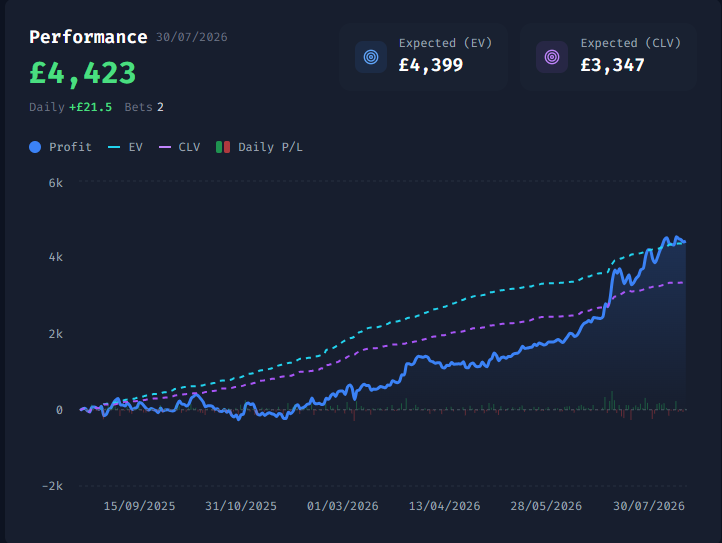
If the answer is consistently yes, you’re probably making profitable decisions even if short-term results fluctuate.
Think Like an Investor
Imagine buying a stock at £80.
A week later, the market values it at £100.
Whether you sell immediately or not, you’ve clearly bought below the market price.
Sports betting works in much the same way.
If you consistently buy odds that later shorten, you’ve effectively purchased an undervalued asset.
That’s why many professional bettors celebrate beating the closing line even after a losing bet.
An Example
Suppose Manchester United are priced at:
2.40
You believe they should be closer to 2.15, so you place your bet.
By kick-off the odds are:
2.12
Your bet loses after United concede in the 94th minute.
Was it still a good bet?
Absolutely.
The market moved strongly towards your opinion.
Over hundreds or thousands of bets, those are exactly the positions you want to be taking.
Recommended Bookmakers and Exchanges That Don’t Limit Winners (Ad)
| Site | Sign Up Bonus | Best For | Link |
|---|---|---|---|
 | £30 Free Bets | Mobile Users | Click Here |
 | 60 days at 0% commission | Matched bettors and value bettors | Click Here |
 | £50 Free Bets | Professional Bettors (May need VPN for access) | Click Here |
 | £30 free bets | Horse Racing Bettors, | Click Here |
 | £30 Free Bets | Traders | Click Here |
Which closing line should I use?
Not all closing odds are equally informative. Soft bookmakers often shade their prices based on recreational betting patterns, promotions, or risk management, while sharp bookmakers like Pinnacle or the betting exchanges accept large stakes from professional bettors and generally operate with much lower margins.
For that reason, many serious bettors use a Pinnacle’s closing line as the benchmark when measuring Closing Line Value (CLV). By kick-off, Pinnacle’s odds have typically incorporated the latest information, market opinion, and sharp action, making them one of the best publicly available estimates of an event’s true probability. While no market is perfectly efficient, consistently beating Pinnacle’s closing line is widely regarded as a strong indicator that you’re finding value.
Removing the bookmaker margin
Even Pinnacle’s closing odds include a small bookmaker margin (also known as the vig or overround). If you want the most accurate measure of value, you should remove this margin before comparing your odds with the closing line.
The process is straightforward:
- Convert both sides of the closing market into implied probabilities.
- Add the probabilities together to calculate the market overround.
- Divide each implied probability by the total overround to normalise them so they sum to 100%.
- Convert the normalised probability for your selection back into decimal odds.
Example
Suppose Pinnacle closes with:
- Home: 1.80
- Away: 2.20
Convert to implied probabilities:
- Home: 1 ÷ 1.80 = 55.56%
- Away: 1 ÷ 2.20 = 45.45%
These total 101.01%, meaning Pinnacle’s margin is approximately 1.01%.
Now remove the margin:
- Home: 55.56 ÷ 101.01 = 55.00%
- Away: 45.45 ÷ 101.01 = 45.00%
Finally, convert these probabilities back into fair odds:
- Home: 1 ÷ 0.55 = 1.82
- Away: 1 ÷ 0.45 = 2.22
Rather than comparing your bet against the quoted closing price of 1.80, you would compare it against the no vig (no marging) fair price of 1.82. This removes the bookmaker’s commission and gives you a cleaner estimate of whether you genuinely beat the market.
Positive CLV Doesn’t Guarantee Wins
This is one of the biggest misconceptions.
Positive CLV does not mean your bet will win.
You can beat the closing line on ten consecutive bets and still lose several of them.
Likewise, you can get terrible CLV and still enjoy a winning weekend.
The difference is what happens over hundreds or thousands of bets.
Long-term profitability comes from repeatedly taking prices that are better than the market’s final assessment—not from chasing short-term outcomes.
Why Winning Isn’t Always Success
Imagine two bettors.
Bettor A
Wins 8 of their last 10 bets.
Everyone thinks they’re on fire.
But every bet closed at better odds than the price they took.
They consistently paid too much.
Eventually, luck is likely to run out.
Bettor B
Loses 6 of their last 10 bets.
It feels frustrating.
However, every single bet beat the closing line.
They’re repeatedly identifying value before the market adjusts.
Over time, Bettor B is usually in the stronger position.
This is why experienced bettors evaluate the quality of their decisions—not just the outcomes.
Why Markets Move
Odds don’t change randomly.
They move because new information reaches the market.
Examples include:
- Team news
- Injury updates
- Weather forecasts
- Suspensions
- Line-up announcements
- Large bets from respected bettors
- Bookmaker risk management
Sometimes public money drives movement.
Sometimes sharp money does.
Either way, the closing line represents the market’s most informed opinion before the event begins.
How Can You Improve Your CLV?
There’s no shortcut, but there are habits that increase your chances of beating the market.
- Shop Around
Different bookmakers often offer different prices.
Even small improvements add up over hundreds of bets.
Never assume your usual bookmaker has the best odds.
- Bet Early (When Appropriate)
Markets are often less efficient when they first open.
If you’ve done your research before everyone else, you may capture prices that won’t last.3.
3.Record Every Bet
Track:
- Odds taken
- Closing odds
- Stake
- Sport
- Profit/Loss
- CLV
You’ll quickly discover whether you’re consistently beating the market, regardless of short-term results.
Key Takeaways
- Closing Line Value compares your odds with the final market price before kick-off.
- Positive CLV is one of the strongest indicators of long-term betting skill.
- A winning bet isn’t always a good bet.
- A losing bet isn’t always a bad bet.
- Focus on consistently making decisions that outperform the market rather than obsessing over short-term results.
- Over time, good prices tend to beat good luck.
The best bettors don’t measure success by yesterday’s result.
They measure it by whether they consistently found value before everyone else.